
Urs of Khawaja Moinuddin Chishti
Urs of Khawaja Moinuddin Chishti is observed on 6 Rajab of the Islamic (Hijri) calendar.
Urs of Khawaja Moinuddin Chishti dates
| Year | Saudi Arabia (Umm al-Qura) | India / Pakistan / Bangladesh (expected) |
|---|---|---|
| 1446 AH | Monday, 6 January 2025 | 7 January 2025 |
| 1447 AH | Friday, 26 December 2025 | 27 December 2025 |
| 1448 AH | Tuesday, 15 December 2026 | 16 December 2026 |
| 1449 AH | Saturday, 4 December 2027 | 5 December 2027 |
| 1450 AH | Thursday, 23 November 2028 | 24 November 2028 |
| 1451 AH | Monday, 12 November 2029 | 13 November 2029 |
| 1452 AH | Saturday, 2 November 2030 | 3 November 2030 |
Gregorian dates are calculated and may change by a day depending on the moon sighting in your country.
Get a reminder for this event
The free app notifies you before every Islamic event.

Hazrat Khawaja Moinuddin Hasan Chishti R.H (536–633 AH / 1141–1236 CE), universally known as "Gharib Nawaz" (Benefactor of the Poor) and "Sultan-ul-Hind" (Spiritual King of India), was the founder of the Chishti Sufi order in the Indian subcontinent and one of the most influential saints in the history of Islam. He was born in Sistan (modern-day Iran/Afghanistan) into a Sayyid family descended from Hazrat Imam Hussain R.A. He lost his parents at a young age and inherited a garden and a grinding mill — it is narrated that one day a majzoob (God-intoxicated saint) named Ibrahim Qandoozi visited his garden, and young Moinuddin offered him grapes.
The saint gave him a piece of bread to eat, and upon consuming it, his heart was illuminated with divine love and he renounced the world immediately. He traveled extensively across the Islamic world — studying in Samarkand and Bukhara, then becoming the devoted mureed of Hazrat Khawaja Usman Harooni R.H in Baghdad, under whom he completed his spiritual training over 20 years of rigorous discipline. It is narrated that Prophet Muhammad ﷺ appeared to him in a dream and commanded him: "Go to Ajmer, India.
Allah will grant you great victory through you for Islam there." He arrived in Ajmer during the reign of Prithviraj Chauhan around 587 AH (1191 CE). The Hindu priests and jogis opposed him fiercely — one famous miracle narrates that the jogis had dried up all water sources to force him to leave. Gharib Nawaz R.H sent his servant with a bucket to the Ana Sagar lake, and despite the jogis' spells, the bucket filled miraculously and water flowed abundantly, breaking their power completely.
Another famous karamaat: a camel-driver refused to give him water in the desert. Gharib Nawaz R.H struck his staff on the ground and a spring gushed forth — that spring flows to this day near Ajmer. Through his spiritual magnetism, humility, and service to the poor, he attracted thousands to Islam without any force — entire communities embraced the faith through his love and compassion alone.
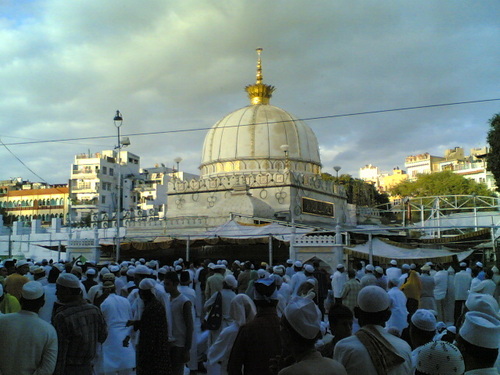
His dargah in Ajmer, Rajasthan, is one of the most visited shrines in the world, attracting people of all faiths — Hindus, Muslims, Sikhs, and Christians alike come seeking blessings. The Mughal Emperor Akbar walked barefoot from Agra to Ajmer in gratitude for the saint's blessings. His annual Urs spans six days (1st–6th Rajab) and draws millions of devotees from across the globe, featuring Qawwali in the dargah courtyard, massive langar feeding hundreds of thousands, and the famous "Jannati Darwaza" opening ceremony.
His timeless teaching: "Love all and hate none" remains a beacon of universal compassion.