
Urs of Hujjat Ul Islam Hamed Raza Khan
Urs of Hujjat Ul Islam Hamed Raza Khan is observed on 17 Jumada al-Awwal of the Islamic (Hijri) calendar.
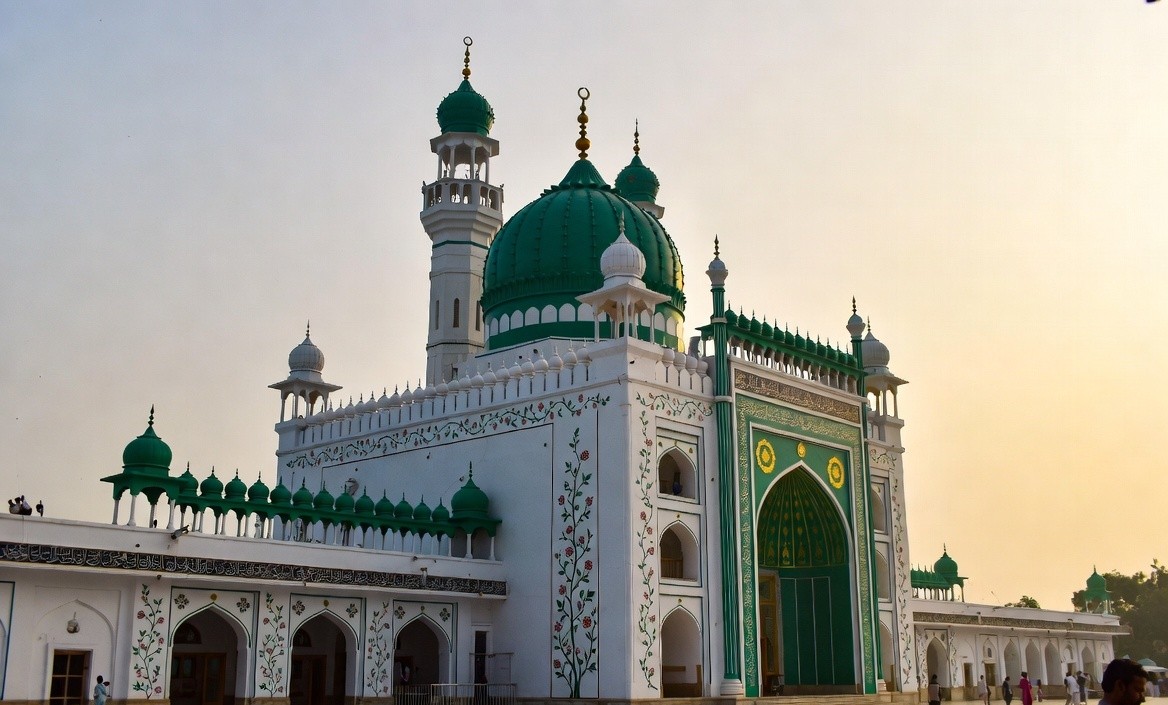
Urs of Hujjat Ul Islam Hamed Raza Khan dates
| Year | Saudi Arabia (Umm al-Qura) | India / Pakistan / Bangladesh (expected) |
|---|---|---|
| 1447 AH | Saturday, 8 November 2025 | 9 November 2025 |
| 1448 AH | Wednesday, 28 October 2026 | 29 October 2026 |
| 1449 AH | Sunday, 17 October 2027 | 18 October 2027 |
| 1450 AH | Friday, 6 October 2028 | 7 October 2028 |
| 1451 AH | Wednesday, 26 September 2029 | 27 September 2029 |
| 1452 AH | Sunday, 15 September 2030 | 16 September 2030 |
Gregorian dates are calculated and may change by a day depending on the moon sighting in your country.
Get a reminder for this event
The free app notifies you before every Islamic event.

Hazrat Maulana Hamid Raza Khan R.H (1292–1362 AH / 1875–1943 CE), honored with the title "Hujjat-ul-Islam" (Proof of Islam), was the eldest son and spiritual successor of Aala Hazrat Imam Ahmed Raza Khan R.H — the Mujaddid of the 14th Islamic century and the greatest Sunni scholar of the Indian subcontinent. He was born and raised in Bareilly Shareef in the extraordinary household of Aala Hazrat, where Islamic scholarship, devotion to the Prophet ﷺ, and spiritual practice permeated every moment of daily life. He received his education directly from his illustrious father, mastering the Islamic sciences at a remarkably young age.
He was the father of Huzoor Mufti-e-Azam Hind Maulana Mustafa Raza Khan R.H — thus serving as the crucial link between Aala Hazrat and Mufti-e-Azam in the golden chain of scholarship that defines the Barelvi tradition. His title "Hujjat-ul-Islam" was earned through his mastery of Islamic theology and his ability to present Islam's proofs with such clarity and force that opponents could find no response — he was literally the "proof" that silenced all objections. He continued his father's mission of defending Sunni beliefs with scholarly precision, authoring important works on Aqeedah and Fiqh and participating in scholarly debates that upheld the honor of the Prophet ﷺ against those who sought to diminish it.
He was known for his extraordinary memory — like his father, he could recall texts verbatim and would cite references with page numbers from memory during discussions. He managed the scholarly and spiritual institutions of Bareilly Shareef after Aala Hazrat's passing, ensuring that the Manzar-e-Islam madrasa and the family's spiritual legacy continued to flourish and serve the community. He was deeply devoted to the practice of Salawat upon the Prophet ﷺ and maintained the family tradition of composing and reciting Naat poetry in praise of the Messenger.
Among his karamaat, it is narrated that he would sometimes inform visitors of their questions before they asked — a sign of kashf (spiritual unveiling) that demonstrated his elevated spiritual station inherited from his blessed father. His annual Urs on the 17th of Jumada al-Awwal is observed with great reverence in Bareilly Shareef with Fatiha, Quran Khwani, scholarly gatherings, and Naat recitals honoring this vital link in the golden chain of Barelvi scholarship.