
उर्स ताजुद्दीन बाबा नागपुर
उर्स ताजुद्दीन बाबा नागपुर इस्लामी (हिजरी) कैलेंडर की 26 मुहर्रम को मनाया जाता है।
उर्स ताजुद्दीन बाबा नागपुर की तारीख़ें
| साल | सऊदी अरब (उम्म अल-क़ुरा) | भारत / पाकिस्तान / बांग्लादेश (अनुमानित) |
|---|---|---|
| 1447 हिजरी | सोमवार, 21 जुलाई 2025 | 22 जुलाई 2025 |
| 1448 हिजरी | शनिवार, 11 जुलाई 2026 | 12 जुलाई 2026 |
| 1449 हिजरी | गुरुवार, 1 जुलाई 2027 | 2 जुलाई 2027 |
| 1450 हिजरी | सोमवार, 19 जून 2028 | 20 जून 2028 |
| 1451 हिजरी | शुक्रवार, 8 जून 2029 | 9 जून 2029 |
| 1452 हिजरी | मंगलवार, 28 मई 2030 | 29 मई 2030 |
अंग्रेज़ी तारीख़ें हिसाब से निकाली गई हैं और आपके देश में चाँद दिखने के अनुसार एक दिन आगे-पीछे हो सकती हैं।
इस दिन का रिमाइंडर पाएं
मुफ़्त ऐप हर इस्लामी दिन से पहले आपको सूचना देता है।

Hazrat Tajuddin Muhammad Badruddin R.H (1861–1925 CE) was one of the most extraordinary and renowned Sufi saints of modern India, based in Nagpur, Maharashtra — a majzoob (God-intoxicated saint) whose outward unconventional behavior concealed the deepest oceans of spiritual wisdom and divine closeness. He was born in Nagpur into a Sayyid family and showed signs of spiritual election from childhood — he would disappear for hours to pray in solitude and would make statements about future events that invariably came true. His spiritual states became so intense that his family, unable to understand his condition, had him committed to the mental asylum of Nagpur — where he spent approximately 16 years.
Yet even within the asylum walls, his spiritual authority was undeniable — guards, doctors, and fellow inmates all recognized his extraordinary station, and devotees would visit him there seeking blessings and guidance. Among his famous karamaat during his asylum years, it is narrated that he would accurately predict events happening in distant cities, cure illnesses that doctors had declared hopeless, and speak in languages he had never learned — all while officially classified as "insane" by the British colonial authorities. He was eventually released through the persistent efforts of his devotees, particularly the Nawab of Doha and other influential followers who recognized his true spiritual station.
He spent his later years in Nagpur in relative freedom. His cryptic utterances — often dismissed by the uninitiated — were later found to contain precise predictions about world events, including both World Wars, the partition of India, and other major historical developments. He was known for his complete indifference to worldly comforts — wearing torn clothes, eating whatever was given to him, and sleeping wherever he happened to be — yet radiating a spiritual power that drew thousands to his presence.
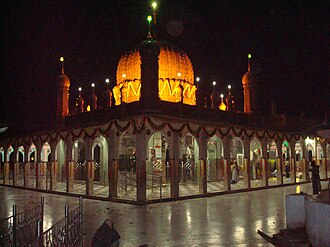
His shrine complex in Nagpur is a major pilgrimage site featuring a beautiful mosque and a peaceful garden. His annual Urs on the 26th of Muharram draws thousands from across India — Hindus and Muslims alike — who come seeking the blessings of this extraordinary saint whose madness was the highest sanity.